Quercus rubra (Red Oak)
“I sat in the shade of the tree, near a crushed gravel walking path, in an arboretum at the edge of a small city, with my back leaning on the trunk of the tree—seemingly listening with, rather than to the tree. I wondered what would the tree hear if it were listening? It felt as thought the tree was supporting me.”
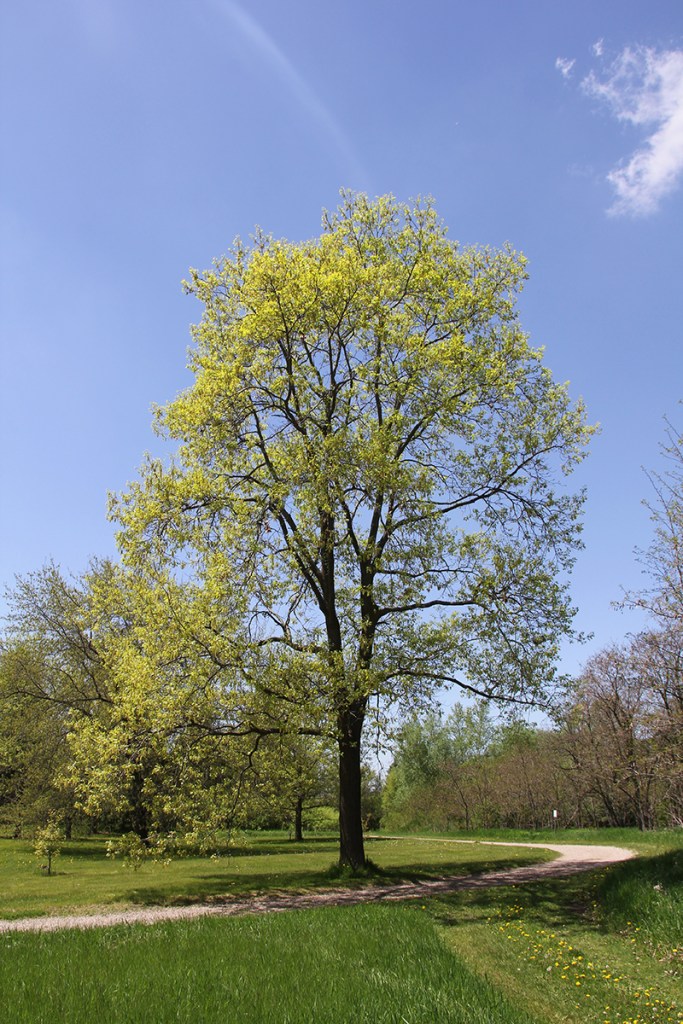
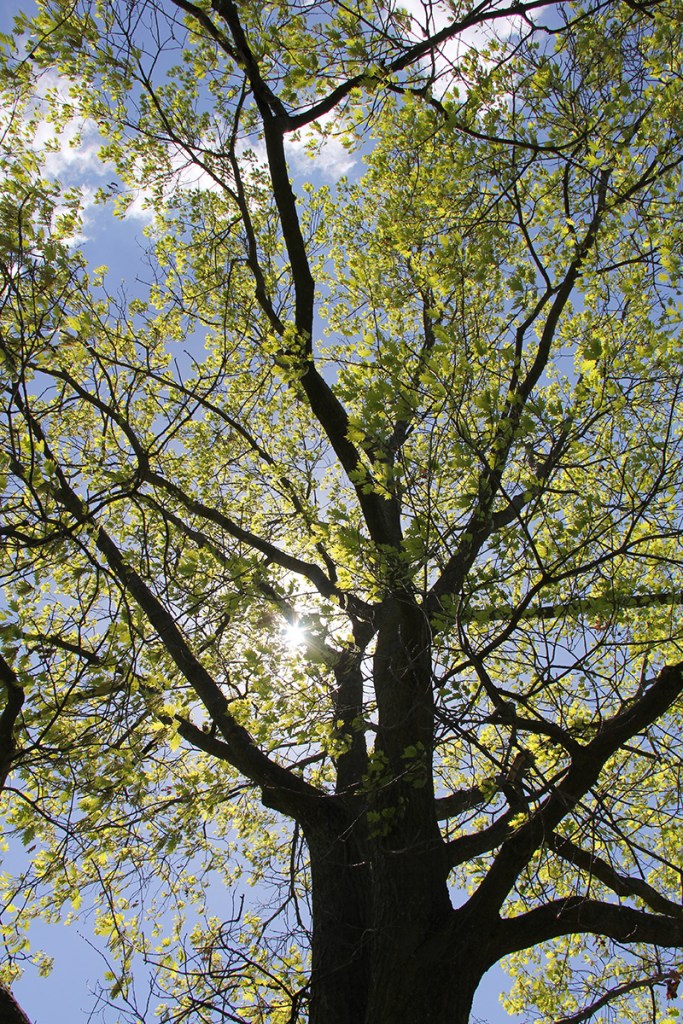
The Red Oak that is the focus of the recording and a view of the tree’s canopy. The sky was brilliantly sunny. Images: Jordan Zalis
The Red Oak is a deciduous tree that typically reaches 75–100 feet in height, with some specimens growing as tall as 120 feet. Its straight trunk is free of branches for a significant distance above the ground, supporting a broad canopy that is often three-quarters the height of the tree. The dark bark is characterized by long, smooth plates separated by deep furrows. Its leaves have bristle-tipped lobes, and the tree’s fall foliage can range from crimson and golden-orange to russet.
As the northernmost of the eastern oaks, this species is also the most important red oak used in lumber production. It is commonly harvested for flooring, furniture, mill-work, railroad cross-ties, mine timbers, fence posts, pilings, and pulpwood.
The Red Oak is also a popular shade and street tree, known for its attractive form and dense foliage. One of the fastest-growing oaks, it is easy to transplant, resilient in urban environments, and tolerant of cold temperatures.
 arboreus.earth